What Comes Out of the Tap Matters: A Private Well Checklist for Spillway Bridge Buyers
The lake view has a way of ending conversations. You step onto the deck, the water goes glassy, and suddenly the question of where the water comes from feels impolite. But around Spillway Bridge, plenty of homes are not on a municipal line. They run on wells — some drilled in the 1970s, some shared with a neighbor, some with a pump that is older than the deck furniture. The good news is that a well is readable. You just have to read it before closing day.
Pull the Paperwork Before You Turn On the Faucet
Start by asking for the well log, sometimes called a driller's report. It usually lists depth, casing size, the yield measured when the well was drilled, and the static water level. Treat it as a snapshot, not a warranty. A well that made six gallons per minute in 1988 may make less now, or more. Still, it tells you what kind of system you are dealing with and whether anyone has touched it since.
Ask for the pump's age and any service records. A pump is a wear item, like a water heater, and it does not announce its retirement. If nobody knows how old it is, assume it is on the clock and budget accordingly.
While you are outside, look at the wellhead. The casing should sit above grade, be capped and sealed, and have the ground sloping away from it. A low cap in a low spot is an invitation for runoff, and runoff is how bacteria find their way in.
The Test That Tells the Truth
A bacteria test alone is not a water test. It is the floor, not the ceiling. Ask for total coliform and E. coli, yes, but for a lake-area home, broaden the panel: pH, hardness, nitrates, arsenic, lead, iron, manganese, and total dissolved solids. Arsenic matters in parts of the North Carolina Piedmont where granite and bedrock are in play. Not every well has it, but enough do that the extra few dollars are worth it. Lead is worth checking if the plumbing predates 1986 or if there is a softener with brass fittings.
Use a certified lab. The North Carolina State Laboratory of Public Health offers well water kits through county health departments, and private certified labs are another option. Follow the sampling instructions. Do not pull the sample through a softener or filter if you want to know what the well itself is doing. Use a clean tap, respect the hold time, and read the full report — not just the line that says pass or fail.
Iron, Sulfur, and Other Flavor Notes Nobody Ordered
Iron shows up as rust stains in toilets, an orange tint on laundry, and a metallic taste. Sulfur is the rotten-egg smell, sometimes only on hot water — which can be an anode rod issue — and sometimes on cold, which points to the well. Manganese leaves black staining. None of these are automatically health emergencies, but they are maintenance and money.
Treatment ranges from a softener to an iron filter to air injection or chlorination. Ask what equipment conveys with the house, how old it is, and who has been servicing it. A softener that has not had salt in two years is a decorative fiberglass tube. A treatment system that nobody understands is worse than no system at all.
Pressure, Storage, and the Shower Test
The pressure tank is the well's shock absorber. A failed bladder shows up as a pump that short-cycles — click, click, click — and pressure that surges or fades. Ask the well contractor to check the tank pre-charge, the pressure switch settings, and the pump's amp draw.
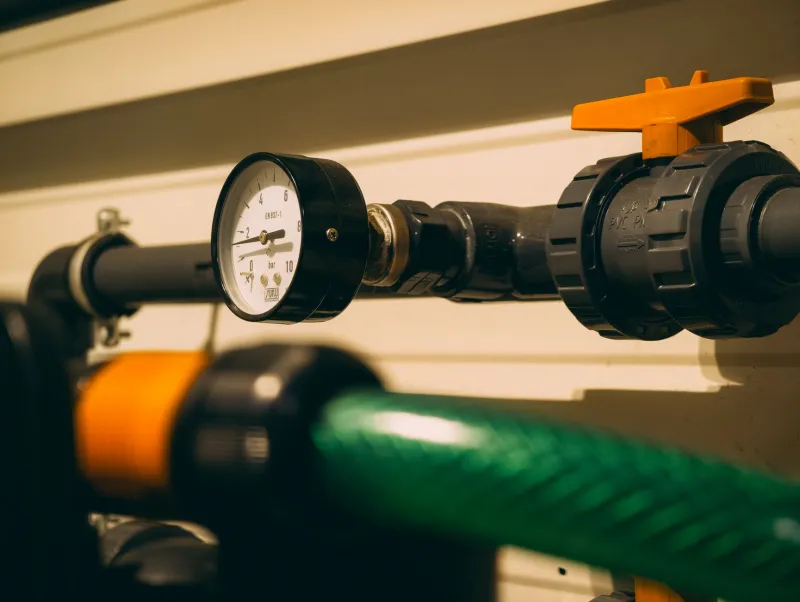
Then do a flow test that resembles real life. Run a shower, the kitchen sink, and an outdoor spigot for twenty or thirty minutes. Watch the pressure gauge. If it sags and does not recover, you have found your first negotiation item. Recovery rate — the gallons per minute the well can sustain — matters more than the number on the drill log. A four-bedroom house on a two-gpm well is a scheduling problem, not a disaster, but you should know about it before the first houseguest arrives.
Also remember that no power means no pump. Many lake homes have generators or at least a plan. Ask what the plan is.
Shared Wells Are Small Governments
A shared well between two or three properties can work fine, but it is a utility with no board. Get the written agreement. Who pays for electricity, maintenance, and replacement? How are decisions made? What happens if someone does not pay? Where is the easement for the pump truck? And test the shared well itself, not just accept that the neighbor says it is fine. Ask whether the well serves both houses through one line or separate lines, and who owns the pressure tank.
Questions to Put in Front of the Inspector
- When was the well drilled, and how deep is it?
- What was the tested yield, and what is the current recovery rate?
- How old is the pump, and what is the static water level?
- Is the casing sealed and capped above grade?
- What did the lab test for, and can I see the full report?
- Does the treatment equipment convey, and who services it?
- Is there a shared-well agreement, and can I read it?
- What happens to water pressure when two fixtures run at once?
The Bottom Line
A well is not a dealbreaker. Around Spillway Bridge, it is just part of the address. But it is the part you cannot see from the deck, and the part that shows up every morning. Spend a few hundred dollars on testing and an hour with a well contractor before you fall for the view. The lake will still be there.